
Getting in Touch
Please contact us with any questions, comments or suggestions.
GOJO Industries, Inc.
P.O. Box 991
Akron, OH 44309-0991
USA
T 1-800-321-9647
F 1-800-329-4656
Please contact us with any questions, comments or suggestions.
P.O. Box 991
Akron, OH 44309-0991
USA
T 1-800-321-9647
F 1-800-329-4656

GOJO, Inc. recently hired Dr. Chip Manuel as the company’s Food Safety Science Advisor. With a strong passion for food microbiology research and a PhD in food science, Dr. Manuel is an expert in norovirus and Listeria – and continues to publish papers and speak at international conferences to bring awareness to major food safety concerns.
As a 25-year veteran of public health, I have experienced several iterations of the Ohio Uniform Food Safety Code. Based on the FDA Model Food Code, state regulations change due to newly-discovered scientific evidence and are influenced by the input of industry, regulators and academia.
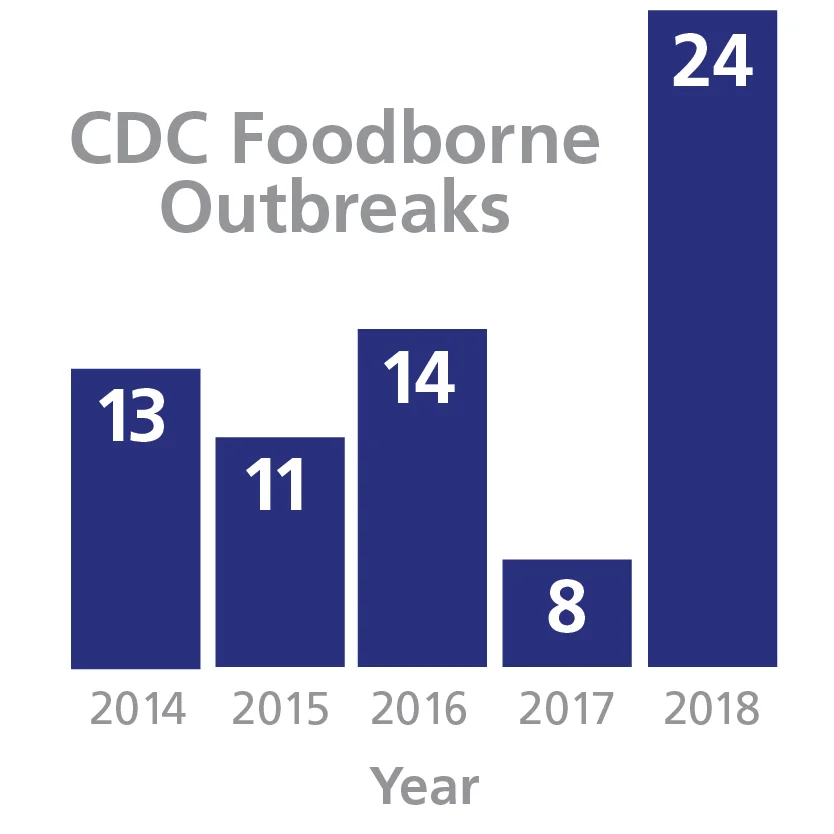
Romaine lettuce. Tahini. Raw meat. Pre-cut melon. These were just some of the foods that made the news in 2018 as part of a record high number of foodborne illness outbreaks. While foodborne illness outbreaks typically peak in the summer, 2018 was perceived to be higher than in recent years. What caused this perception?
It’s a new year, filled with new hopes and dreams, and a time we make resolutions for ourselves to improve both personally and professionally. What about New Year’s resolutions for our restaurants? How would we like our restaurants to improve in the next year? Chew on this: A study found that 60% of guests said a positive experience will cause them to dine at the restaurant more frequently. Also, researchers found that if you can bring back 5 percent of your customer base in a variety of industries, it could result in a surge in revenue of 25 percent to 125 percent. Imagine your bottom line if more than 5 percent of your guests became repeat visitors?!
There’s a common misconception about cruise lines that has plagued the industry for years. “The cruise-ship virus” – or Norovirus, as it’s known on land – is most commonly associated with illness outbreaks on cruises. But what does all this have to do with restaurants? Don’t worry – we’re getting there…
It’s no secret that Norovirus is a major issue facing the foodservice industry, due to its frequency and ability to spread quickly. Food safety protocols are an invaluable tool to keep guests safe from illness, but they’re only half the picture. You may be monitoring what’s coming in the back door in the way of supplies, but do you know what’s walking in the front door with your employees?
Restaurant operators are asked to do a lot of things, and just maintaining cleanliness standards can be full-time job, in and of itself. Preventing cross-contamination is one of the most important ways to keep guests & employees safe from foodborne illness.
Although the “bucket and rag” method may be the industry standard for cleaning surfaces in restaurants, if not performed properly, these techniques can be ineffective at best. Cleaning and sanitizing with reusable towels requires constant monitoring of the sanitizing solution, the surfaces being cleaned, and the towels themselves.
A comprehensive body fluid spill kit is one of the most important tools food safety teams can include as a part of their overall risk management plans. The benefits outweigh the relatively minor costs of including response kits as a part of an organization’s protocols. There are three main reasons why organizations should seriously consider investing in body fluid spill kits.
© 2016 - 2020 GOJO Industries, Inc. All rights reserved.
This site is published by GOJO Industries, Inc. It is intended for visitors from the United States.
Home | About GOJO | Terms of Use | Contact Us




Recent changes to the U.S. food codes call for the inclusion of a written plan to address body fluid spills. Yet, not all response plans are the same, making it important for you to have a proper plan for bodily fluid accident clean-up. The following response plan outlines a recommended defense against unplanned accidents and spills involving body fluids like vomit, blood and diarrhea.